.jpg?sfvrsn=d9e817f_1)


Understanding Heavy-Duty Rotary Die Cutters: Benefits and Uses in Box Cutting
Corrugated containers are an integral part of our economy; they protect goods in transit, support warehouse efficiency, and increasingly carry branding, product details, and retail-ready features that influence how a product is perceived the moment it lands on a shelf. Increasingly, packaging is also expected to act as an experience for consumers, and match growing sustainability values for both regulatory and marketing purposes.
Because corrugated packaging is expected to perform all of those jobs at scale, converters need equipment that can keep up without sacrificing precision. Heavy-duty rotary die cutters play a central role in corrugated converting by turning corrugated sheets into finished, printed, shippable packaging with consistent cut quality, reliable creases, and repeatable results. MarquipWardUnited, a BW Papersystems brand, pioneered the rotary die cutter, helping shape modern corrugated conversion and boxmaking as we know it today.
Let’s break down what rotary die cutters are, how they work, why they are essential in box making, and what makes BW Papersystems’ rotary die cutters a preferred option for high-output converting customers.
What is a Rotary Die Cutter?
A rotary die cutter is a corrugated converting machine that can die cut and convert corrugated sheets into usable packaging. In other words, it is not only a “box cutting” machine. It is often a one-pass converting platform that helps turn corrugated board into finished, printed, packaging components efficiently.
Rotary die cutters use a rotating cylindrical die working against an anvil to perform cutting, scoring, and creasing as sheets move continuously through the machine. Many configurations also include inline printing (commonly flexographic) so graphics, product information, and brand elements can be printed accurately at production speeds.
At a high level, the process looks like this:
- Corrugated sheets feed into the machine
- Optional inline printing applies packaging graphics and product messaging at high speeds
- A rotating die cylinder and anvil perform cutting, scoring, and creasing as the board continues moving
- The machine outputs packaging blanks ready for downstream folding, gluing, bundling, and shipment
This continuous motion approach is a big reason rotary die cutting is associated with high productivity compared to flatbed die cutting. Rotary systems maintain throughput while producing repeatable packaging results, including reliable print-to-cut consistency when printing is integrated inline.
The Essential Role of Rotary Die Cutters in Box Making
Rotary die cutters sit at the heart of corrugated conversion because they enable converters to produce custom, high-quality packaging. When you are running thousands (or millions) of boxes that must assemble cleanly and perform reliably in real-world handling, the details matter. Rotary die cutters also support modern packaging needs by enabling inline printing at high speeds, which produces packaging that is both functional and brand-ready without adding separate processing steps.
Cutting Accuracy
Consistent cutting helps ensure each box blank matches intended dimensions, with clean edges that support smooth folding.
Scoring Consistency
Scoring creates the fold lines that determine how a box forms. Consistent scoring supports efficient assembly, reduces cracking or fiber damage, and helps maintain the structural integrity of the finished product.
Creasing for Strength
Creases are not just where the box folds, they help define how corrugated packaging handles compression, stacking, and the stresses of shipping.
Reducing Waste in Corrugated Conversion
When cutting and scoring are accurate and repeatable, you typically see less scrap, fewer rejected blanks, and less rework. Rotary die cutters can also reduce waste compared to more manual approaches because they are designed to run consistent setups at production scale.
Typical Use Cases of Rotary Die Cutters
Rotary die cutters are widely used for packaging needs that go beyond standard shipping cartons, including:
- Retail-ready packaging that needs clean presentation and fast shelf stocking
- Custom-sized shipping boxes designed to reduce void fill and improve pack density
- Complex die-cut packaging like display-ready designs, cutouts, and specialty structures
The Invention of the Rotary Die Cutter: Ward’s Pioneering Innovation
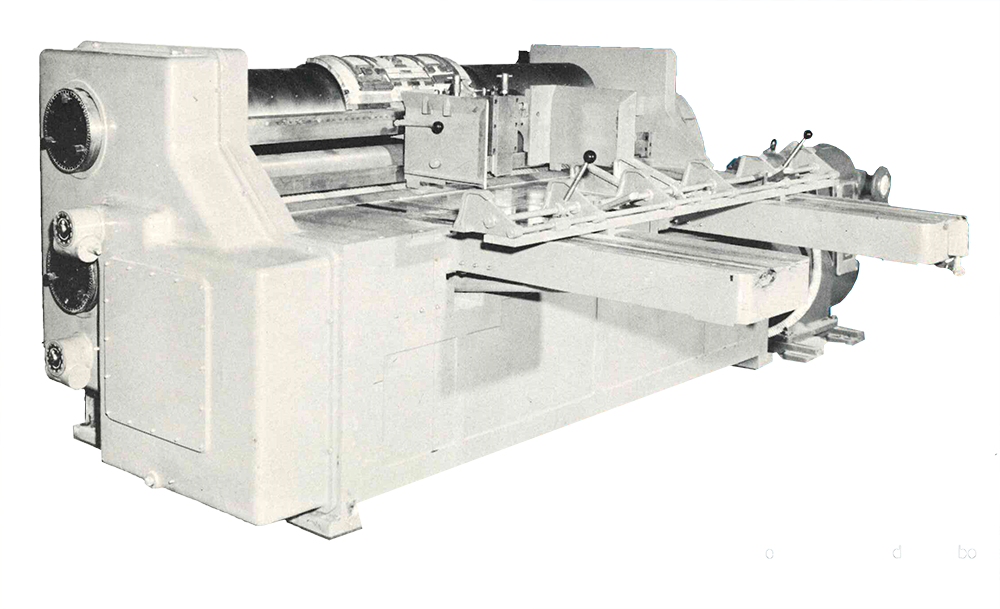
Long before rotary die cutting became a standard in corrugated converting, die cutting itself evolved from earlier industrial manufacturing needs and eventually found its way into packaging as demand grew for faster, more repeatable production. That demand only accelerated as box designs became more complex and volumes climbed. Boxmakers needed a better way to produce precision cuts and scores, without relying on slower, stop-and-start approaches.
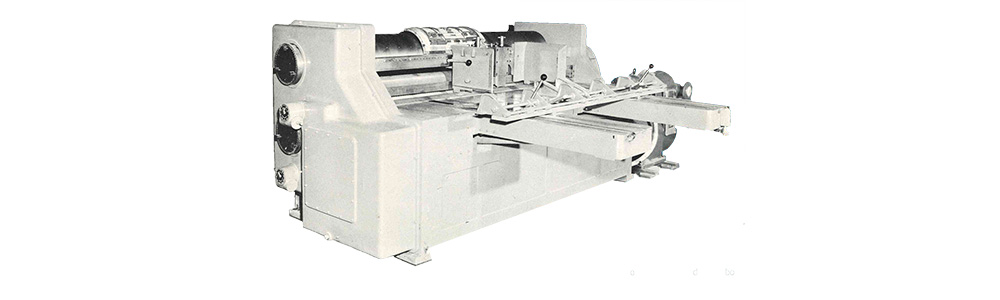
In the early 1960s, Ward Machinery introduced a new concept for corrugated converting: soft anvil rotary die cutting. Bill Ward, built the first commercially successful Rotary Die Cutter, a 50” x 80” machine. His goal was to create a machine that was twice as strong, ran three times as fast, and cost half as much as the competition. Over time, the rotary die cutter became one of the most impactful machine innovations in corrugated packaging, because it fundamentally changed how quickly and reliably converters could produce boxes.
Ward Machinery has long since become MarquipWardUnited, a trusted brand under BW Papersystems that continues to carry on the legacy of innovation Bill Ward left behind. We’ve continued to improve on our rotary die cutters over the years, increasing speed and throughput, quality, accuracy, and sustainability, all while maintaining a lower cost of ownership that means more revenue per box.
Why BW Papersystems’ Rotary Die Cutters Are the Industry’s Best
Rotary die cutters may follow the same fundamental concept, but the results depend on machine design, build quality, control systems, and how reliably the machine holds registration and performs at speed.
There’s a reason we’re known to thousands of customers across the globe as the best rotary die cutter manufacturer. BW Papersystems’ rotary die cutters excel in areas that matter for real-world converting environments:
- Robust construction designed for high-volume, long-life operation
- Industry-leading registration systems to support precise, consistent converting
- User-friendly controls that support faster job setup and reduced downtime
- Advanced sheet handling such as vacuum or lead-edge feeding for reliable feeding and control
- A commitment to continuous improvement in design and technology, plus global support and service networks that help customers maintain performance over time
Just as importantly, BW Papersystems offers a broader finishing and converting portfolio, which is helpful if you are updating a full line, modernizing, or aligning die cutting with upstream and downstream equipment.
The G-Grafix Rotary Die Cutter
The G-Grafix Corrugated Rotary Die Cutter is a rugged, production-grade machine built for demanding corrugated converting environments. It is designed to print and die cut accurately and consistently, and to maximize output with quick setup, a user-friendly interface, and a low cost of ownership. The G-Grafix supports inline printing at high speeds, allowing converters to produce brand-ready packaging without adding separate printing passes.
The MaxPro Rotary Die Cutter
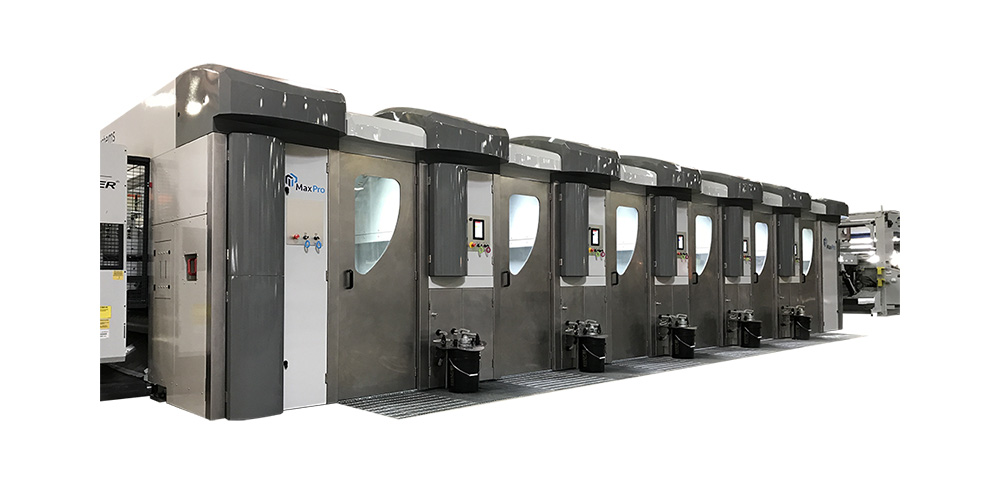
Our highest-volume RDC, the MaxPro is built to produce high output while maintaining print and converting consistency. It is designed to support inline, high-speed printing plus die cutting in one continuous workflow, helping plants reduce extra handling and separate passes through production.
Key features include:
- Dual belt drive system for durability and performance, paired with fast cutting die mounting and removal to support quicker changes and reduced downtime.
- Automatic “on the fly” anvil cover trimming maintains consistent converting results.
- Fixed frame architecture with pitted print units support excellent print quality. The pitted design supports set-up-while-run print plate changes, so teams can prepare the next job while the machine continues running.
- Customizable print sections, with 2 to 6 print units available, which helps match the machine to different packaging and graphics requirements.
The ServoPro Rotary Die Cutter
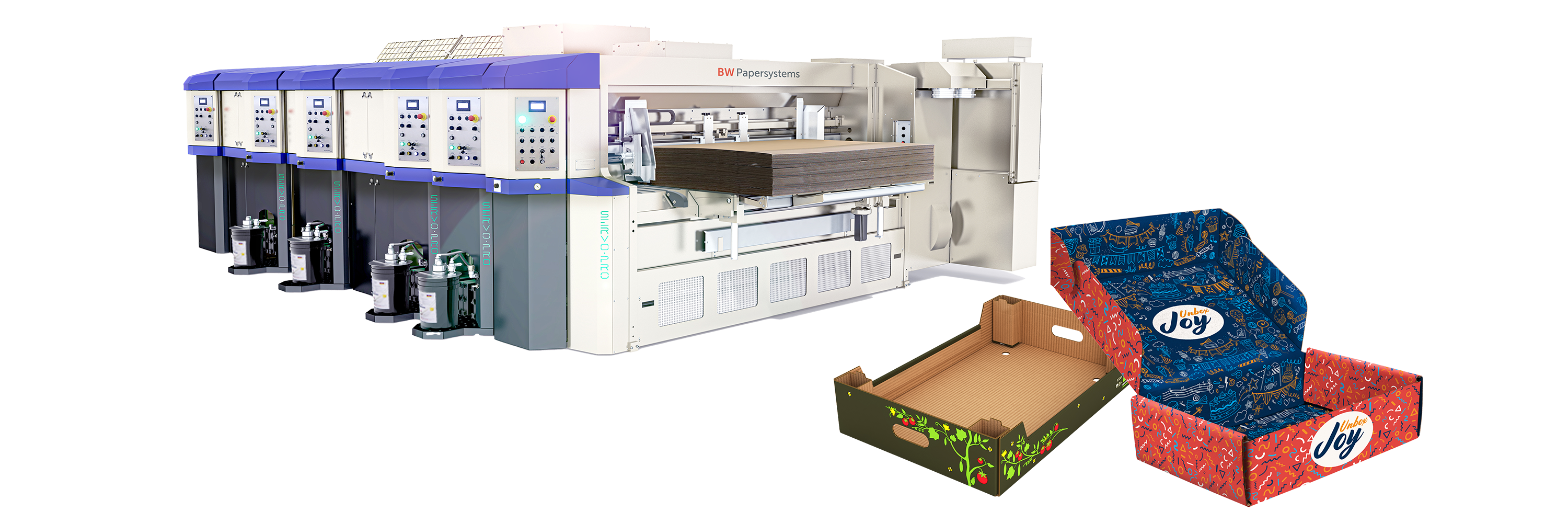
The ServoPro is a robust, open-and-close, servo-driven rotary die cutter built around an ultra-heavy-duty die cut system for high-output corrugated printing and converting. It uses a true direct servo drive system that is directly coupled to key print components, improving control and reducing maintenance complexity by removing intermediary gearboxes or chain assemblies.
ServoPro is positioned for versatility and throughput, rated up to 200 sheets per minute. It utilizes a robust system, with increased journal size, bearing capacities, and drum stiffness, making it one of the most heavy-duty die cutters for its size, designed to handle full-cylinder jobs with significant rule content at high speeds.
ServoPro is available in multiple sizes, including:
- 16.32 ServoPro RDC – 1676 mm x 3251 mm (66" x 128")
- 16.28 ServoPro RDC – 1676 mm x 2870 mm (66" x 113")
The Key Benefits of Choosing a BW Papersystems Rotary Die Cutter
Choosing a heavy-duty rotary die cutter is a strategic decision, it impacts throughput, labor efficiency, and the ability to deliver packaging that meets customer expectations for both performance and presentation. That’s why there’s no better choice than a BW Papersystems’ rotary die cutter.
These are the key differences that set BW Paperystems apart from other brands when it comes to die-cutting.
Faster Production Speeds
Our rotary die cutters are built for high output. The ability to cut, score, crease, and often print inline makes rotary die cutting a strong fit for converters managing high-volume demand and tight timelines.
Compared to flatbed approaches, rotary systems offer higher productivity and throughput because they are designed to run continuously at speed. In practical terms, that can mean:
- More finished blanks per hour
- More consistent output across long runs
- Better ability to keep pace with the rest of a converting operation without becoming a bottleneck
Reduced Maintenance Costs
Heavy-duty converting equipment is expected to run hard, and reliability is a major factor in total cost of ownership. That’s why BW Papesystems manufactures all of our rotary die cutters to stand the test of time. Whether you’re running a small converting line or need massive throughput at speed, we have a machine to match your goals. This includes:
- Heavy-duty components designed to minimize wear and extend machine life
- Easier access that simplifies routine maintenance tasks
The bottom line is: Easier maintenance and longer-lasting components for BW Papersystems rotary die cutters can reduce unplanned downtime and help keep production schedules on track
Flexibility for Diverse Box Styles and Sizes
Corrugated packaging requirements are not one-size-fits-all. Even within a single plant, you might run:
- Small, intricate die cuts for specialty packaging
- Larger shipping cartons and high-run regular slotted containers
- Retail-ready and display-ready designs that require consistent cut quality
A rotary die cutter that supports faster changeovers and a wide operating range helps businesses adapt to changing customer needs without dedicating machines to challenging packaging types.
Applications of Rotary Die Cutters Across Industries
Rotary die cutters support packaging needs across a wide range of industries because they combine high-throughput corrugated converting with the ability to add graphics and product messaging inline at production speeds. Below are common industry applications:
E-commerce and Direct-to-Consumer Packaging
E-commerce packaging has to do two jobs at once: Protect the product through a high-handling shipping environment and represent the brand on delivery. Rotary die cutters help support this by producing boxes and die cut designs while featuring exceptional consistent print quality for consistent branding.
Common packaging outputs include:
- Right-sized shipping cartons to reduce void fill and improve pack density
- Subscription and direct-to-consumer boxes with higher graphic expectations
- Packaging with die-cut features like pull tabs, locking tabs, and interior fit elements
- Inside print applications like instructions, brand messaging, or unboxing details.
Food and Beverage Packaging
Food and beverage corrugated packaging is often produced in high volume and expected to perform under stacking loads, cold chain conditions, and repeated handling.
Typical use cases include:
- Shipper cases and trays used for distribution and shelf replenishment
- Club-store and bulk packaging
- Beverage carriers and specialty die cut structures that require accurate folds
Electronics and Consumer Goods Packaging
Electronics and consumer goods packaging often require precision, not only for appearance, but to protect sensitive products. Rotary die cutters support tight tolerances for die cut inserts, partitions, and packaging features that reduce movement during transit.
Common electronics packaging includes:
- Protective packaging with partitions, pads, and die cut inserts
- Packaging designed for automation, consistent folds and predictable forming
- Branded packaging that needs clean presentation and accurate registration
Point-of-Sale Displays and Retail-Ready Packaging
Retail-ready packaging and displays require a higher level of print quality and structural accuracy. Rotary die cutters are often used for these applications because they can handle die cut complexity while also supporting high-graphic printing.
Common outcomes include:
- Shelf-ready cases and “tear-away” display packaging
- Pop-up and counter displays
- Die cut windows, tabs, and presentation features
- Consistent print-to-cut alignment for branded packaging
Get in Touch with BW Papersystems Today!
Ready to upgrade your corrugated converting line? Contact a BW Papersystems representative today to discuss your packaging goals, production requirements, and the right rotary die cutter configuration for your operation, including options that support high-speed inline printing and one-pass converting.
.tmb-webp.webp?Culture=en&sfvrsn=6cca827f_4 "Contact Banner")